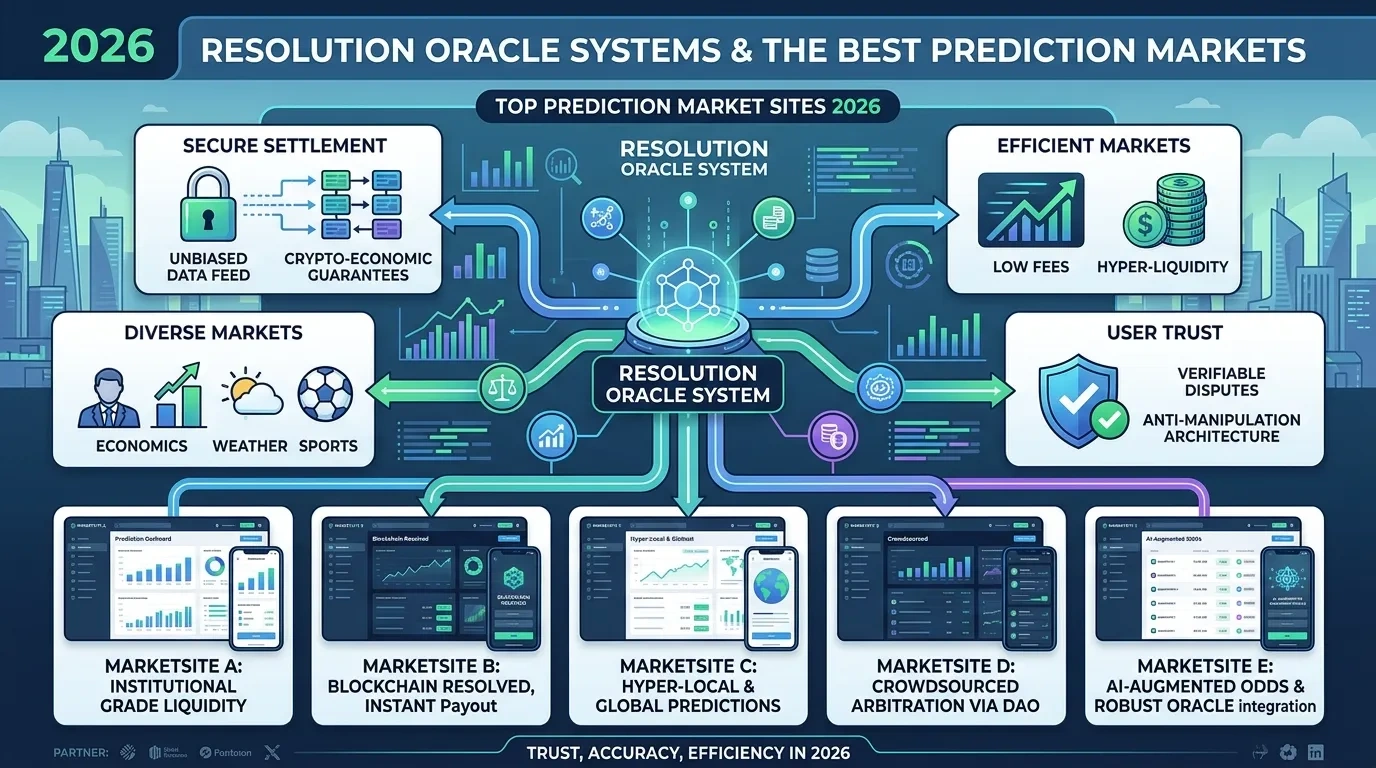
Resolution oracle systems use three core metrics to show which prediction market sites lead in 2026. These metrics are event coverage, resolution speed, and reliability. The website https://predictionmarketscomparer.com/ has data on how each oracle manages outcomes.
Oracle functions that matter most in 2026 include:
- Oracles resolve event outcomes onchain;
- Oracles connect data feeds to market processes;
- They set rules for outcome status;
- They trigger payouts once settlement ends;
- Oracles coordinate dispute management with stakeholder.
What Are Resolution Oracle Systems
Oracle systems link blockchain markets to data. They connect streams to contracts. Without these systems, markets do not close positions or send winnings. Resolution oracles use checks to confirm outcomes and trigger settlements. When an event ends, the oracle records the result in the ledger. This action starts transfers.
Oracle types vary by data input method and validation structure: Oracle types differ by how they get data and how they check that data.
- API feed;
- Aggregation from sources;
- Reporter input;
- Hybrid of automated and manual checks;
- Vote by holders.
Event Resolution Process Steps
Resolution cycles improve capital efficiency. Participants can use funds in contracts within hours. These processes help keep results accurate. They lower returns.
- After the oracle gets data from sources, it sends the outcome to the contract.
- The window opens for a time. During this period, any participant can dispute the outcome.
- A disputer must post a bond. The bond must match or exceed the stake.
- The layer checks each side’s evidence. It makes a decision.
- Settlement happens onchain. holders get their winnings.
- return to the party whose claim won.
- The market closes. It does not reopen.
Bond Economics in Oracle Systems
Bonds link reporters through risk. Proposers must state outcomes to keep their funds safe. If a proposal fails, the proposer loses the bond. When a proposal is correct, the proposer gets the bond back and earns a reward. A $100 bond can protect a $500 pool. For a $50,000 market, a $5,000 bond can block claims. Dispute bonds follow this same process. Collateral is needed for interest, which keeps resolutions possible.
Financial structures behind oracle operations include several bond categories: The structure behind oracle operations uses several types of bonds.
- The bond covers each new submission;
- The bond lets people challenge a result;
- The stake grants the right to take part;
- The bond lets unresolved cases go up for review;
- The pool pays those who reach outcomes.
Dispute Mechanism Layers
Disputes move through a series of tiers that focus on speed and accuracy. Early tiers catch mistakes quickly. Challenge systems let users dispute outcomes by posting counter-bonds within a window. At later tiers, voting groups or arbiters review all evidence. Each layer adds a check, which lowers error rates and raises the cost for unsupported claims. This system protects traders from mistakes and aligns resolution costs with the size and complexity of each market.
Resolution progresses across five clear stages:
- The process starts when the challenge window opens;
- If someone posts a counter-bond, the dispute advances to the review layer;
- Community voting examines the submitted evidence;
- If the parties still disagree, a council of arbiters can review appeals;
- The final settlement becomes permanent and cannot be changed.
How Does UMA Optimistic Oracle Work
Proposers submit outcome statements and lock bonds. UMA checks each assertion. A challenge window opens next. This period lasts between 24 and 72 hours. Disputers can post counter-bonds to escalate the process. If no dispute occurs, the assertion becomes final. The Data Verification Mechanism then starts a vote among token holders. UMA has resolved more than 22,000 cases. Disputes occurred in only 1.67 percent of them.
UMA’s core components depend on economic incentives and coordination.
- Data Verification Mechanism;
- Schelling-point voting;
- Proposal model;
- Bond security;
- Token holder arbitration.
Self-Resolving Market Structures
Crowd consensus replaces data feeds in self-resolving markets. These markets close when the group’s final forecast sets the reference outcome. Traders update one shared prediction until a stopping rule triggers. The last k contributors split a reward pool. Payment goes to participants who improve forecast accuracy. This model reduces the costs of market resolution.
Mechanics that power self-resolution include:
- A stopping rule selects the forecaster;
- Traders update one forecast in order;
- Early traders receive rewards for accuracy;
- The last k traders divide a reward;
- No oracle feed is required.
Resolution Speed and Capital Lock
Challenge windows set the length of time that funds stay frozen after an event ends. Some systems resolve these events. These systems can return capital within hours, so traders can move funds into new contracts several times each month. Slow challenge windows keep funds locked for days or even weeks. This delay blocks new trades. However, it can help catch oracle errors before settlements become final. Traders must consider the wait for fund access against the safety from errors that review periods provide.
Short versus long resolution structures create distinct tradeoffs:
- A release lets funds compound;
- A review gives time to find mistakes;
- A window offers a balance;
- Markets often choose speed;
- Events with rules usually need time.
Contract Design for Fewer Disputes
Sites that use market terms get more volume. They see fewer escalations. When a site defines metrics, sources, and boundaries at the start, it runs with fewer delays and errors. Contract language lowers the number of disputes. It also helps operations grow.
Contract specification elements that reduce conflicts include:
- Metric definition;
- Time boundaries;
- Source reference;
- Unit of measurement;
- Fallback rules.
What Oracle Factors Matter for Site Selection
Before making decisions about which prediction market sites to use, traders evaluate how an oracle functions. Analysts examine the dispute rate, how frequently a first decision is challenged; resolution duration, the time it takes to deliver a final answer after the event has been concluded; and evaluate the stack type, whether the prediction market sites use UMA, contracts, or a combination. Finally, traders look for bond transparency, making the stakes and reward information visible to the community.
These criteria are useful in evaluating sites based on:
- Oracle stack type
- Percentage of previous disputes
- Transparency in stake value
- Average resolution duration
- Availability of the escalation rule
Oracle Development Through 2026
By 2026 we expect oracle stacks to become increasingly automated. And with the growing number of domain-specific modules, we expect the automated resolution cases of sports, finance, and politics to become increasingly commonplace. An automated LLM judge will be able to take a contract and resolve a data stasis dispute. The Checks & Balances framework will be implemented. The first automated proposals will be generated, and only after a set period will these be validated by a human. New tools will be introduced for measuring dispute case resolution across multiple domains and systems, as well as automated voting in multiple languages. As Bonds increase, so will the amount of capital invested and the challenges to systems. The automation of settlement windows will take a matter of days.
Below are the predictive models for the upcoming trends in oracles and resolution systems:
- Domain-specific resolution modules
- LLM-based judges for disputes
- Automated cross-domain resolution systems
- Tiered Bond pricing systems
- Days-long settlement windows